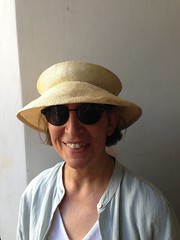
I'm a writer, publishing both as SJ Rozan and, with Carlos Dews, as Sam Cabot. (I'm Sam, he's Cabot.) Here you can find links to my almost-daily blog posts, including the Saturday haiku I've been doing for years. BUT the blog itself has moved to my website. If you go on over there you can subscribe and you'll never miss a post. (Miss a post! A scary thought!) Also, I'll be teaching a writing workshop in Italy this summer -- come join us!
Read/Post Comments (6)

NI hao! Yach-SHIM-eh-sis!
"Ni hao" is "hello" in Mandarin, the official Chinese of China. "Yachshimesis" is "hello" in Uighur, which Uighurs are allowed to teach and publish in because they're an Autonomous Region. But the Uighur kids all have to learn Chinese in school, too, and the kids whose parents have really high hopes, both Chinese and Uighur, are learning English after school. So this is a typical scene on the street, from Xi'an to Kashgar:
A group of kids, anywhere from six to sixteen, spotting a westerner, will say "hel-LO" and then giggle madly. If you respond, "hello," they'll hoot with laughter. They may run away; or the boldest and most hardworking will go on to line two in the lesson book: "How are YOU?" You say, "Fine, how are YOU?" and they'll answer. "I am fine." Then you wait. If they've really studied the lesson, and their friends aren't giving them too hard a time, they'll say, "What is you NAME?" You have to say, "My name is SJ, what is YOUR name?" Anything else and they're lost. If you say this, you'll get, "My name is Ahmed," given name only for the Uighur kids, or "My name is Liu Jong Wu," full name if the kid's Chinese. Then, "Where are you FROM?" You answer, "America," and you get the final sentence in the lesson. The kid smiles and says, "I think America is very (fill in the adjective)." I've heard "pretty," I've heard "big," and the best I've heard is "I think America is very funny."
Then comes the hard part. That's the end of the conversation in the lesson book. By now the kids are rolling in the aisles, except the one who's been talking to you; he or she is beaming with pride. But then you're tempted to ask, "Where are YOU from?" That's a mistake, it turns out. What you need to ask, if you have any hope of keeping the conversation going into uncharted territory, is, "Kashgar is your hometown?"
The concept of "hometown" is enormously strong in China, among all ethnic groups -- the Han, who make up 95% of the population, and everybody else. No one but the most adventurous wants to leave their hometowns. They want to get jobs there, marry hometown honeys, settle down and raise their kids there. Even a pit like Lanzhou is Lanzhou peoples' hometown, and they don't want to leave it. We don't think like this. I'm a proud Bronx native, and I love New York, but that's because what New York is resonates with what I want, not because I was born there. If it didn't, or if it stops, I'd move to Seattle or Santa Fe in a heartbeat.
But here, it's different. When the kids ask where you're from, it's because you're obviously not where you belong. You came from somewhere. They didn't. They have no way of answering where they're "from." They're not FROM here. They ARE here.
A group of kids, anywhere from six to sixteen, spotting a westerner, will say "hel-LO" and then giggle madly. If you respond, "hello," they'll hoot with laughter. They may run away; or the boldest and most hardworking will go on to line two in the lesson book: "How are YOU?" You say, "Fine, how are YOU?" and they'll answer. "I am fine." Then you wait. If they've really studied the lesson, and their friends aren't giving them too hard a time, they'll say, "What is you NAME?" You have to say, "My name is SJ, what is YOUR name?" Anything else and they're lost. If you say this, you'll get, "My name is Ahmed," given name only for the Uighur kids, or "My name is Liu Jong Wu," full name if the kid's Chinese. Then, "Where are you FROM?" You answer, "America," and you get the final sentence in the lesson. The kid smiles and says, "I think America is very (fill in the adjective)." I've heard "pretty," I've heard "big," and the best I've heard is "I think America is very funny."
Then comes the hard part. That's the end of the conversation in the lesson book. By now the kids are rolling in the aisles, except the one who's been talking to you; he or she is beaming with pride. But then you're tempted to ask, "Where are YOU from?" That's a mistake, it turns out. What you need to ask, if you have any hope of keeping the conversation going into uncharted territory, is, "Kashgar is your hometown?"
The concept of "hometown" is enormously strong in China, among all ethnic groups -- the Han, who make up 95% of the population, and everybody else. No one but the most adventurous wants to leave their hometowns. They want to get jobs there, marry hometown honeys, settle down and raise their kids there. Even a pit like Lanzhou is Lanzhou peoples' hometown, and they don't want to leave it. We don't think like this. I'm a proud Bronx native, and I love New York, but that's because what New York is resonates with what I want, not because I was born there. If it didn't, or if it stops, I'd move to Seattle or Santa Fe in a heartbeat.
But here, it's different. When the kids ask where you're from, it's because you're obviously not where you belong. You came from somewhere. They didn't. They have no way of answering where they're "from." They're not FROM here. They ARE here.
Read/Post Comments (6)
Previous Entry :: Next Entry
Back to Top